- 2026-03-14
Absorption in Water Treatment
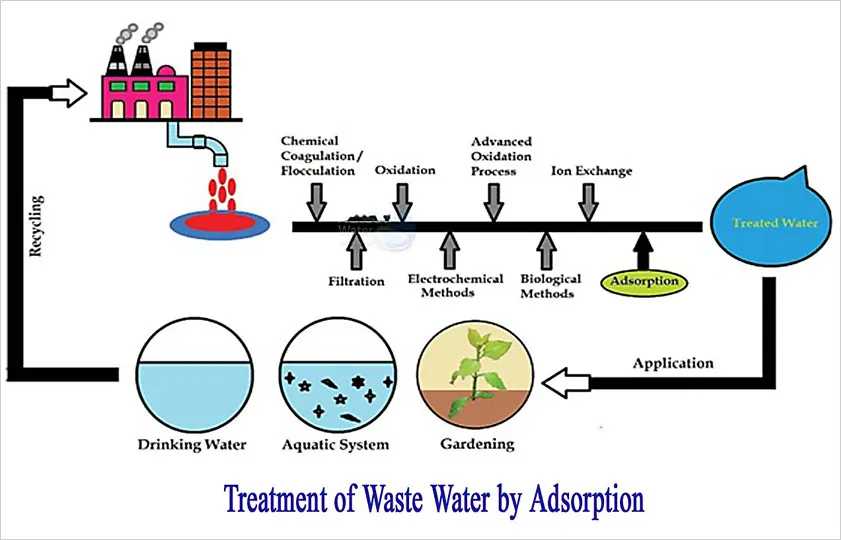
Absorption is a gas-liquid mass transfer process used in water treatment, primarily to remove contaminants found in industrial waste gases and wastewater odors (such as CO2, NH3, and H2S). This article discusses the operating principles, key parameters, equipment selection, and industrial applications of the absorption process. It also clearly distinguishes absorption from "adsorption," providing a reliable data reference for engineering design.
What Is "Absorption" in Water Treatment? Core Definitions and Principles
In water treatment, absorption is a process in which contaminant molecules – present in either gaseous or liquid phases – dissolve and then disperse uniformly throughout an absorbent medium by diffusion. The removal of these contaminants occurs through subsequent chemical or physical reactions. Unlike surface-based "adsorption," absorption is typically used to remove dissolved gases or specific dissolved contaminants present at high concentrations; it is a distinct form of mass transfer.
Absorption refers to the process by which contaminant molecules dissolve through a phase interface and diffuse into the bulk liquid phase, with the following technical characteristics:
Absorption vs Adsorption in Water Treatment | Key Differences
| Parameter | Absorption (Water Treatment) | Adsorption (Water Treatment) |
| Site of Action | Overall liquid phase (absorbent solution) | Solid phase surface (adsorbent material) |
| Driving Force | Concentration gradient / Henry's Law | Van der Waals forces / Chemical bonds |
| Kinetics | Gas-liquid mass transfer controlled | Pore diffusion controlled |
| Core Application | Gaseous pollutant removal (NH3, H2S, CO2) | Solid/liquid pollutant adsorption (heavy metals, organics) |
Water Treatment Absorption Applications
Absorption is widely used for the removal of malodorous pollutants and toxic gases, with a proven record of industrial applications and high removal efficiencies.
| Target Pollutant | Recommended Absorbent | Core Reaction Equation | Removal Rate |
| Ammonia (NH3) | Sulfuric Acid (H₂SO₄) Solution | 2NH₃ + H₂SO₄ → (NH₄)₂SO₄ | >99% |
| Ammonia (NH3) | Sodium Hydroxide (NaOH) Solution | H₂S + 2NaOH → Na₂S + 2H₂O | 95-98% |
| Carbon Dioxide (CO₂) | MEA Solution (Monoethanolamine) | CO₂ + 2HOCH₂CH₂NH₂ → HOCH₂CH₂NHCOO⁻ + HOCH₂CH₂NH₃⁺ | >90% |
Key Engineering Parameters For Water Treatment Absorption
Mass transfer coefficient (Kₗa): 0.005-0.03 s⁻¹ (packed tower conditions)
Henry constant (H): Determines gas-liquid equilibrium (NH₃: 0.76 atm·m³/mol)
Liquid-to-gas ratio (L/G): 1-10 L/m³ (adjusted based on pollutant solubility)
Water Treatment Absorption Equipment | Selection and Performance
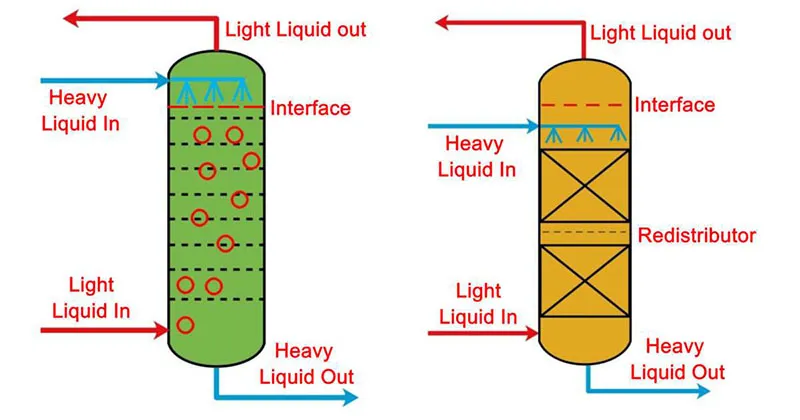
Three common types of tower-based absorption equipment, their specific applications, advantages, and limitations. Selection depends on industrial requirements:
.Bubble Tower
Scope of Application: Gaseous pollutants with high solubility (e.g. NH3, SO2)
Advantages: Long residence time (10–60 s), stable treatment performance
Limitations: High energy consumption (> 3 kW/m³), high operating costs
.Packed Tower
Scope of Application: Waste gas with low to medium pollutant concentrations (provided it does not contain high levels of solids)
Advantages: Low pressure drop (ΔP < 500 Pa/m), high mass transfer efficiency
Limitations: Prone to clogging when suspended solids (SS) content exceeds 50 mg/L; requires periodic cleaning
.Spray Tower
Scope of Application: Waste gas containing high levels of solids or dust-laden gases
Advantages: Strong resistance to clogging, simple operation, convenient maintenance
Limitations: Low mass transfer efficiency (approx. 60%)—suitable for preliminary treatment
Industrial cases For Water Treatment Absorption
Wastewater treatment plant odor removal system
Absorbent: 5% sodium hypochlorite solution
Design load: H₂S 200ppm → outlet <5ppm
Filler height: ≥3.5m (ensuring contact time >8s)
Flue Gas Desulfurization (WFGD)
Limestone slurry concentration: 15-20%
SO₂ removal efficiency: >98% (pH maintained at 5.2-5.8)
Demister requirements: Liquid carryover <50 mg/Nm³
Get Custom Water Treatment Absorption Solutions
Our team of water treatment engineers offers comprehensive, one-stop services, including design, equipment selection, and installation, for absorption systems specifically engineered to remove industrial gaseous pollutants such as NH3, H2S, and SO2. Whether you require wastewater treatment or odour control, we can tailor a bespoke solution to your specific requirements, taking into account both pollutant concentrations and on-site conditions.